Alfred J. Lewis
Chesapeake Bay Maritime Museum, Uncurated Search Results
Type: Skipjack
Year: 1905
Builder:
Location: Hopkins

These records are found in the collection of the Chesapeake Bay Maritime Museum in St. Michaels, Maryland. Uncurated search results are presented to give researchers and interested readers an idea of whether CBMM’s archives contain information about this vessel and whether it may be worthwhile to contact CBMM for further investigation. Uncurated results may be inaccurate or incomplete.
For more information about these items, contact the CBMM curator at collections@cbmm.org, or use the selection buttons below to submit a research request.
Search mode: Exact Name. Search phrase(s): "Alfred J. Lewis"; "Alfred J Lewis". Results returned: 6. Results displayed in this table: 6.
Use these buttons to send uncurated search results to your own app or text document for further research. First, check the box for any row, or click "Select All" then uncheck any rows. Then click "Show Selections". You can then copy your selections from the text box and past them into your app.
| Fetch? | Row ID | Catalog # | Object Name | Title | Artist/Maker | Date Made | Place Made | Description | Full Image | CBMM Cat. Page |
|---|---|---|---|---|---|---|---|---|---|---|
| 1 | 8888.0096.0000.00 | documents | Lumber Industry Documents:BackgroundThe mate | Lumber Industry Documents:BackgroundThe material in this collection was acquired by purchase from various sources. It consists of two receipts, a time-keeper's book, a book listing lumber sales and shipments, a ledger of 304 pages, and a sheet found in the time-keepers book listing expenses for trips.Scope and ContentThe two receipts are dated 28 September and 30 November 1829 and refer to the receipt on board the sloops Eagle and True Guide of stated quantities of corded oak wood. In both cases the oak wood is for Justes Lowery, apparently of Hall's Landing. The only information about the vessels and Lowery is that contained in the receipts themselves. The location of Hall's Landing is not known.The book listing lumber sales and shipments by K. C. Rice of Craddockville, VA, dates from August 1916 to April 1918, and describes the transactions in detail. Craddockville is located at the head of Craddock Creek, about four miles west northwest of Belle Haven, VA. Most of the lumber, which largely consisted of 35- to 75-foot pilings or "sticks", was shipped by rail, although some was rafted. There are frequent references to Pennsylvania Railroad "car" numbers. Shipments were mostly from such Eastern Shore of Virginia points as Birds Nest Station, Nassawadox Station, Eastville Station, and Machipongo Station. Destinations included Newark and Harrison, NJ, Boston, MA, Buffalo, NY, and Mahanoy City, PA. Some of the "sticks" were sold under contract to the U. S. Government.The time-keeper's book covers the period from April 1910 through October 1910 and November 1912. It lists K. C. and John W. Rice, as well as a number of other employees. It gives the number of days worked per month. Each month is divided into two parts. Although the printed format contains a column for pay "rate per day", no rates are entered, nor is there an entry in the column for total amounts paid. The name K. C. Rice has been entered on the flyleaf at the back of the book.The ledger, which apparently is from the L. J. Houston & Co. of Stockton, MD, covers the period from January 1902 through December 1907. Stockton lies about eleven miles south of Snow Hill, MD, and about three miles north of the Virginia border. The ledger reflects monetary entries for a number of individuals and organizations whose names are shown in an alphabetical index at the front of the volume. In addition, sections of the ledger at pp. 193-209 and 302-304 list weekly rental income for 1909-1910 and1904-1906 respectively.One BoxFolder 1- Two receipts: (1) dated 28 Sept 1829 for eighteen and one half cords of oak wood received on board the sloop True Guide at Hall's Landing by W. | No image URL. | View | ||||
| 2 | 8888.0001.0000.00 | documents | Howard I. Chapelle Papers | Chapelle, Howard I | Exact 01/01/1901 - | The papers of Howard I. Chapelle consist of notes, printed materials, articles by others, some plans and correspondence. Much of the material is not original, but is source material collected by Chapelle.<br /><br />The papers are divided into three basic sections: 1. Correspondence, 2. thematic folders, and 3. whole notebooks by Chapelle. Papers are arranged into the most specific topic heading as possible. However, a researcher would be advised to peruse the subject headings before beginning specific research. | No image URL. | View | ||
| 3 | 8888.0016.0000.00 | documents | Albert E. Brown and Bro Papers<CR><CR>The collection i | Brown, Albert __Creator | Exact 02/01/1988 - | Albert E. Brown and Bro Papers<CR><CR>The collection is comprised of some of the correspondence and business papers concerning the Brown's Sail Loft in Winona, Maryland. Included are many sail plans for work and recreational boats. These papers were retrieved by museum staff from the derelict sail loft with the permission of the owner. Many are damaged or, deteriorated.Biographical BackgroundAlbert E. Brown and Bro/ sail.1oft~:~was located at Wenona, on the southern tip of the island. The Loft was founded in 1870 by Capt. John Stubbs. In 1890 he was bought out by Henry Brown, born in England, and who served as a seaman in the Royal Navy. He learned the art of sailmaking when he came to the United States during the Civil War and joined the United States Navy.Henry constructed the present building. When he retired in 1919 his son Albert took over the sail loft. Albert's son Henry, in turn, started at the loft when he was 12 years old and took over the business in 1956. Henry G. Brown retired about 1980 and the building has stood empty ever since. In 1986 the old sail loft changed hands.In its heyday, the business was one-of the region's leading sailmakers and had a reputation for old-fashioned, quality workmanship. Orders for sails came from all across the country and from overseas.Scope and ContentThis material represents those papers that were salvagable and that remained in the sail loft after the business had closed. They give considerable insight into the operation of one of the country's most well-known sailmakers.The majority of the papers are correspondence written to the sail loft concerning orders for sails, frequently accompanied by a sail plan and an estimate. Of value are a number of sail plans for the oyster dredging fleet, that the loft kept on file for repeat orders, and letters concerning well-known Bay yachts. Many of these boats have long since disappeared. Sail Loft Amps (1923 - 1974)Brown Papers, p 2An index of boats is available.Correspondence was filed under boat name where it was known, and by correspondent's last name if-no specific boat was mentioned (except for one" design boats which are filed under class name).Other papers include"account books and miscellaneous business papers which provide an overview of 1"the finances of a traditional sailmaking business.Sub'ectsSailmaking Subject: Albert E. Brown and Bro. | No image URL. | View | ||
| 4 | 8888.0054.0000.00 | documents | THOMAS C. GILLMER<CR>MANUSCRIPT COLLECTION<CR><CR>Thomas | Exact 01/01/1981 - 12/31/1993 | THOMAS C. GILLMER<CR>MANUSCRIPT COLLECTION<CR><CR>Thomas C.Gillmer was born in 1911 at Warren, Ohio. He became interested in ships at an early age, entering the U.S. Naval Academy and graduating in 1935. During the late 1930s he served aboard light cruisers in the Pacific and Mediterranean. During World War II he served as an instructor in naval construction, damage control, and marine engineering at the Naval Academy, eventually becoming chairman of the naval engineering department. In 1952 Gillmer wrote Naval Construction a Ship Stability, a basic text still in use in the naval architecture program at the Academy. He retired from active teaching at the Academy in 1967 and began to devote full time to the design of yachts and ship replicas. His first successful yacht design was the 1946 Blue Moon. Subsequent designs were the Southern Cross and Seawind series. He designed Pride of Baltimore 3,(1976-77), the pungy Lady Maryland (1979), and Pride 2L Baltimore 11. (1988). Most recently Gillmer prepared a study of the USS Constitution for her overhaul by the navy. He is the author of several books and numerous articles.See also Oral History tape No. 93 with transcript and list of books and articles.The manuscript collection consists of six papers:1. "Signposts Towards the Origin of Ship Design," prepared for the 5th Naval History Symposium, Annapolis, 1 October 1981.2. "Evolving Ship Design Technology As Revealed in Wrecks of Post Medieval Ships." 3rd International Symposium of Boat and Ship Archeology, Stockholm, 1982.3. "Authentic Replica Ships: Theory and Practice." International Symposium on Ship Construction in Antiquity, Delphi, Greece, August 1987.4. "The Importance of Skeleton First Ship Construction to the Development of Rational Ship Design." International Symposium on Ship and Boat Archeology, Amsterdam 1988.5. "The Second Pride of Baltimore, Her Design and Construction." 9th Sailing Yacht Symposium, Annapolis 1989.6. "USS Constitution: An Assessment for Her Future." Naval History Symposium, Annapolis 1993. Subject: Thomas C Gillmer | No image URL. | View | |||
| 5 | 1994.0016.0001.00 | kitchen safes | Pie safe with schooners | 1830-1870 | Pie safe with schooner images punched into tin panels. 2 front doors, each with 3 vertical panels. Patina on all panels. Crisfield. Said to have come from an African-American household. Condition: good, wood worn on edges, LR two tin panels damaged. | 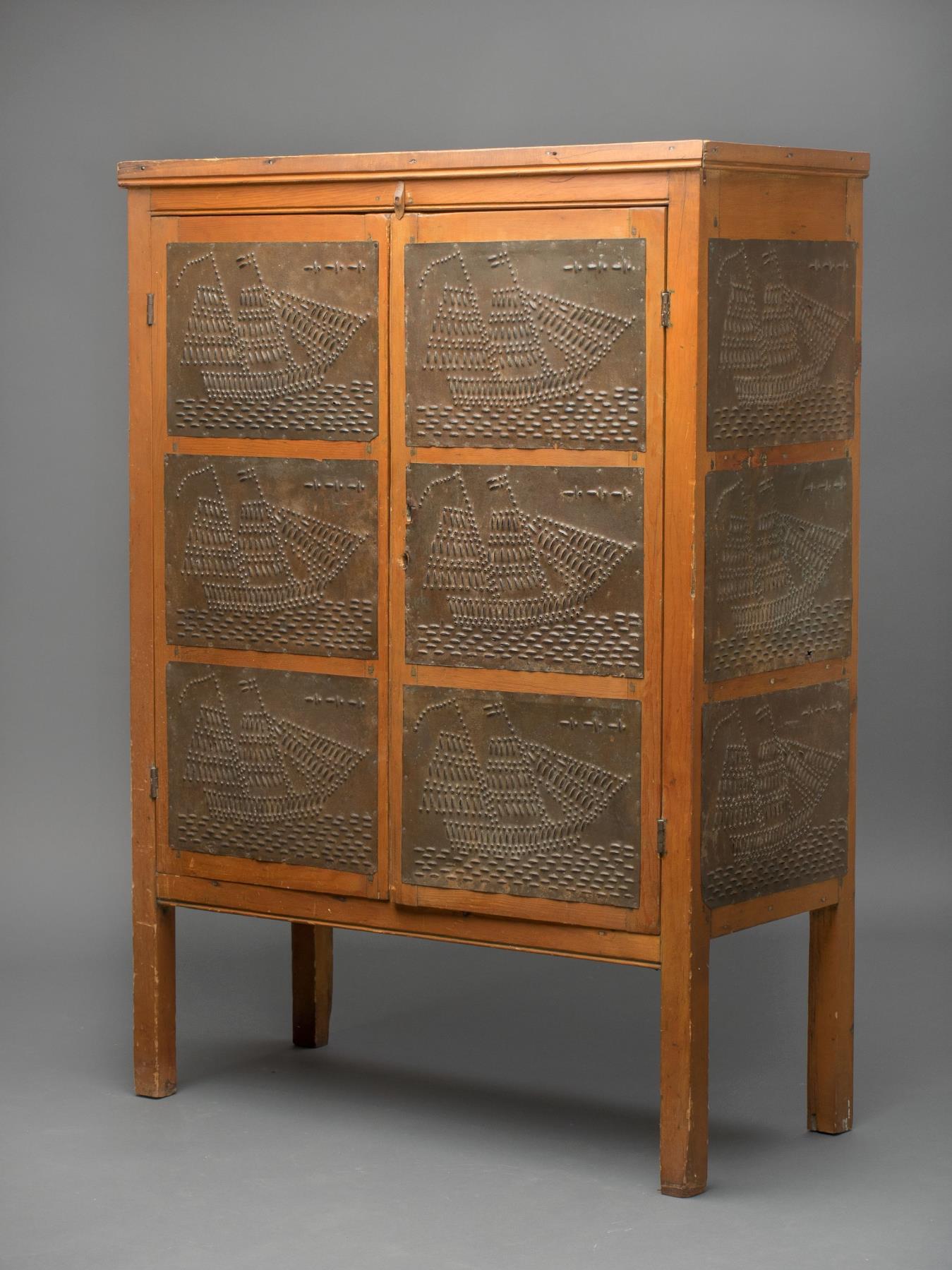 | View | |||
| 6 | 8888.0062.0000.00 | manuscript | Maryland Crabmeat Company Collection | Range, Exa 01/01/1939 - 12/31/1946 | No Address - Crisfield - Somerset - Eastern Shore - MD - 21316 - USA | This collection consists of documentation from the Milboume Oyster Company and the Maryland Crabmeat Company. The Milbourne documents came from a plant in Stockton, MD. The material dates from 1939 to 1946 and is contained in Archival Box 1. The documents are arranged as follows: orders and statements for oysters, clams and crabs; receipts, statements and bills from local supply companies; tax receipts; license information and a list of checks paid out.Maryland Crabmeat Company documents date from 1981 to 1992 and are contained in Banker Boxes 1 through 10. The documents are arranged as follows: sales and inventory of products, bills of lading, taxes and income statements, suppliers and vendors, accounting records, and payroll records. | 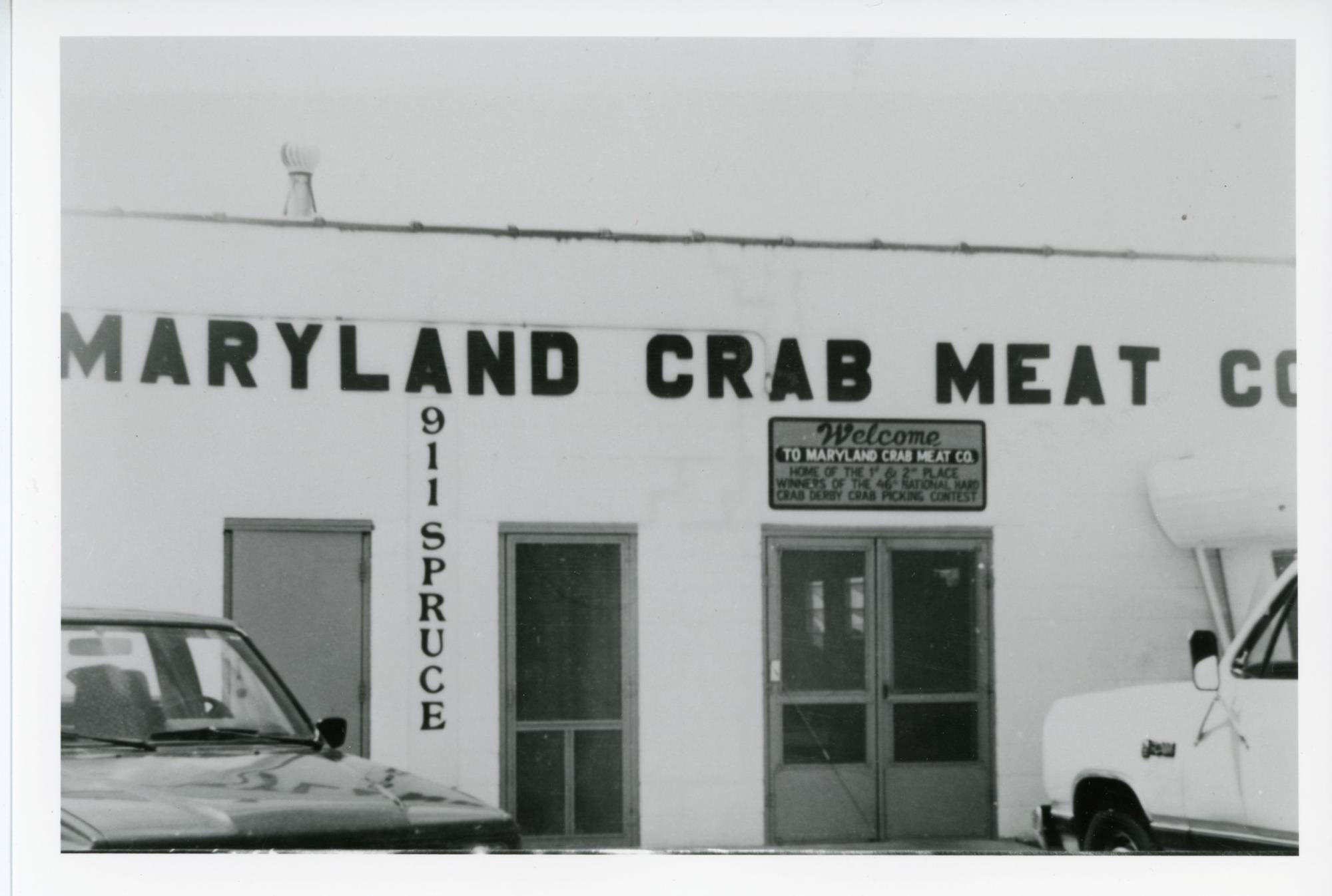 | View |
Created 2026 by Don Barker, CBMM volunteer, for the Chesapeake Shipbuilding Project. shipbuilding@sailingworkboats.es